
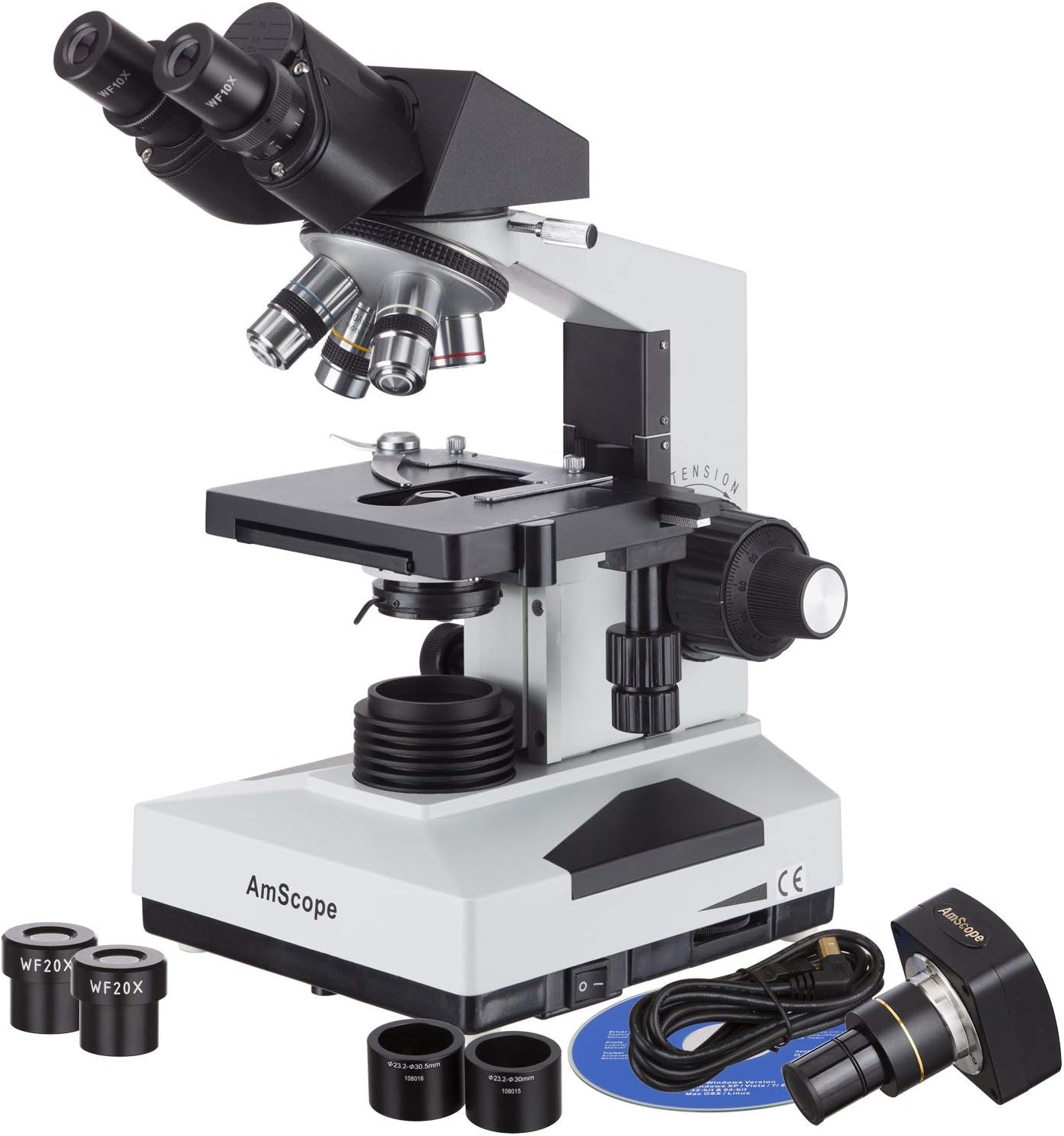
AmScope B490B-P Digital Compound Binocular Microscope, WF10x and WF20x Eyepieces, 40X-2000X Magnification, Brightfield, LED Illumination, Abbe Condenser, Double-Layer Mechanical Stage, Sliding Head, High-Resolution Optics, Anti-Mold, Includes 0.3MP Camera with Reduction Lens and Software
Product details
| Management number | 211702826 | Release Date | 2026/04/04 | List Price | $200.00 | Model Number | 211702826 | ||
|---|---|---|---|---|---|---|---|---|---|
| Category | |||||||||
The AmScope B490B-P digital compound binocular microscope has a sliding head, interchangeable pairs of 10x widefield and 20x widefield eyepieces, a forward-facing nosepiece with four DIN achromatic objectives, Brightfield halogen illumination, a double-layer mechanical stage with a stage stop to protect slides and objectives from damage, and anti-mold surfaces to preserve optics in high-humidity areas. The 0.3MP camera has a CMOS color sensor, a reduction lens, image capture and editing software, and USB 2.0 output to capture or display still or video images on a computer or projector. The compensation-free binocular viewing head has interchangeable pairs of 10x widefield and 20x widefield eyepieces and sliding head to adjust inter-pupillary distance, a fixed 30-degree vertical inclination to reduce eye and neck strain, and a 360-degree rotation capability to provide a more comprehensive view and enable sharing. The sliding head has a range of 55 to 75mm to accommodate individual eye differences, and bi-lateral dioptric adjustment accommodates individual eye-strength differences. The forward-facing nosepiece has 4x, 10x, 40xS (spring), and 100xS (spring, oil) DIN achromatic optical-glass objectives that combine with the eyepieces to provide color correction of magnified images. The 40xS objective is spring loaded to prevent slide damage when focusing. The 100xS spring-loaded oil objective provides increased resolution over a standard objective. A digital compound microscope is used for inspection and dissection of specimens when two-dimensional images are desired, and where image capture, detailed records, or documentation is required.The 0.3MP digital camera has a CMOS color sensor for displaying still microscopy images and streaming live videos to a computer or projector. The camera has 40x magnification and a 0.37x reduction lens that ensures that the display has a similar field of view as the microscope eyepiece. The camera can be mounted in a C-Mount or any 23mm eye tube. The camera includes image capture and editing software that provides still image and live video capture and editing capability, including measurement functions. The software supports JPG, TIF, GIF, PSD, WMF, and BMP file formats and is compatible with Windows XP, Vista, 7, and 8; Mac OS X; and Linux. Camera drivers are compatible with Windows XP, Vista, 7, and 8; Mac OS X; and Linux. The software includes Windows APIs for native C/C++, C#, DirectShow, Twain, and LabVIEW that enable custom application development. The camera has a USB 2.0 data port (cable included).The microscope has lower (transmitted, diascopic) Brightfield illumination that transmits light up through the specimen for enhanced visibility of translucent and transparent objects. Brightfield (BF) illumination allows the specimen to absorb light, resulting in a dark image on a light background. Halogen illumination provides bright light in a concentrated path and has a rheostat to control light intensity. The 1.25 NA Abbe condenser is mounted on a rack-and-pinion control system, can be adjusted to control the distance of the light from the stage, and has an iris diaphragm to optimize the amount of light illuminating the specimen. The double-layer mechanical stage, with 1mm stage divisions, locks the slide into place and provides precise slide manipulation along the X- and Y-axis to allow coordinates to be recorded, enabling the viewer to return to a specific location on the slide. A stage stop prevents the stage from coming into contact with the slide and objectives. The stage is 5-1/2 x 5-1/2 inches (140 x 140mm) and has a traveling range 2-15/16 x 1-3/4 inches (75 x 45mm). Graduated coaxial coarse and fine focus has a focusing range of 1-3/16" (30mm) and fine-focus divisions of 0.002mm (0.0000787") that enable measurements to be taken. Focus knob tension control prevents the stage from drifting out of focus. The solid-metal enamel-coated body is durable and resistant to stains and corrosion. Microscope SpecificationsHeadCompound binocularEyepiecesWF10x, WF20xObjectives4X, 10x, 40xS, 100xS (oil)StageDouble-layer MechanicalLighting configurationTransmitted (lower)Condenser1.25 NA AbbeDiaphragmIrisLight sourceHalogen with rheostat, 6V/20WIllumination typeBrightfieldPower110VOverall dimensions12 x 9 x 16 inches (H x W x D)H is height, the vertical distance from the lowest to highest point; W is width, the horizontal distance from left to right; D is depth, the horizontal distance from front to back.Camera SpecificationsResolution0.3MP (640 x 480 effective pixels)Image typeStill image and video display and captureCamera typeBrightfieldCamera sensor1/4" Aptina CMOS (color)Magnification40xReduction lens0.37xMounting size23mm or C-MountFrame rate79fps at 320x240; 30fps at 640x480Computer connectionUSB 2.0File formatsJPG, TIF, GIF, PSD, WMF, BMPSoftware packageImage capture and editing for Windows XP, Vista, 7, and 8; Mac OS X; and LinuxCamera driver compatibilityWindows XP, Vista, 7, and 8; Mac OS X; and LinuxMicroscopes are instruments used to enhance the resolution of an object or image. Types include compound, stereo, or digital. Compound microscopes use a compound optical system with an objective lens and an eyepiece. Stereo microscopes show object depth in a three-dimensional image. Digital microscopes are used to display an image on a monitor, rather than looking through a lens. Microscopes can have monocular (one), binocular (two), or trinocular (three) eyepieces, with varying magnification abilities. Magnification ability refers to the size of an image. Resolution, also known as resolvant power, refers to the clarity of the image. The interaction between field of view (FOV), numerical aperture (NA), and working distance (WD) determines resolution. Microscopes can control magnification through a fixed focus, or through a range of adjustments. They can also utilize LED, fluorescent, and mirror light sources to help control viewing capabilities. Microscopes are widely used in education, lab research, biology, metallurgy, engineering, chemistry, manufacturing, and in the medical, forensic science, and veterinary industries.United Scope manufactures microscopy equipment and accessories under the brand name AmScope. The company, founded in 1996, is headquartered in Irvine, CA.What's in the Box?AmScope B490B-P microscope with double-layer mechanical stage10x widefield eyepieces, one pair20x widefield eyepieces, one pair4x DIN achromatic objective10x DIN achromatic objective40xS DIN achromatic objective100xS (oil) DIN achromatic objectiveImmersion oil, one bottle(2) Color filters; blue and green0.3MP digital camera (MU035)0.37x reduction lensSoftware CDUSB 2.0 cableSpare halogen bulbSpare fuseInstructions
- Digital compound microscope and a 0.3MP camera w/ reduction lens and USB 2.0 output for capturing or displaying images on a computer/projector, compatible w/ Windows XP/Vista/7/8/10, Mac OSX and Linux
- Binocular sliding head with 10x and 20x widefield eyepieces and 55-75mm interpupillary adjustment, 30-degree inclination to reduce neck strain, and 360-degree rotation capability to enable sharing
- Forward nosepiece with 4x, 10x, 40xS, and 100xS DIN Achromatic precision-ground optical-glass objectives that provide color correction of magnified images, and anti-mold surfaces to preserve optics
- Brightfield, halogen illumination with rheostat to control light intensity, and 1.25 NA Abbe condenser with iris diaphragm and rack-and-pinion focus control for precise focus, clear examination, and light control
- Double-layer mechanical stage with 1.0mm stage divisions and stage stop; and graduated coarse and fine focus with tension control to prevent stage drift
| UPC | 013964504996 |
|---|---|
| Brand | AmScope |
| Voltage | 110 Volts |
| Model Name | B490B-P |
| Unit Count | 1.0 Count |
| Item Weight | 0.01 Ounces |
| Manufacturer | United Scope LLC. |
| Model Number | B490B-P |
| Power Source | Corded Electric |
| Light Source Type | Halogen, LED |
| Enclosure Material | optical glass |
| Real Angle Of View | 30 Degrees |
| Magnification Maximum | 2000 x |
| Manufacturer Part Number | B490B-P |
| Objective Lens Description | Achromatic |


Bestseller ranking
Compound Binocular Microscopes


Customers who viewed this product also viewed
Home Essentials


Correction of product information
If you notice any omissions or errors in the product information on this page, please use the correction request form below.
Correction Request Form