
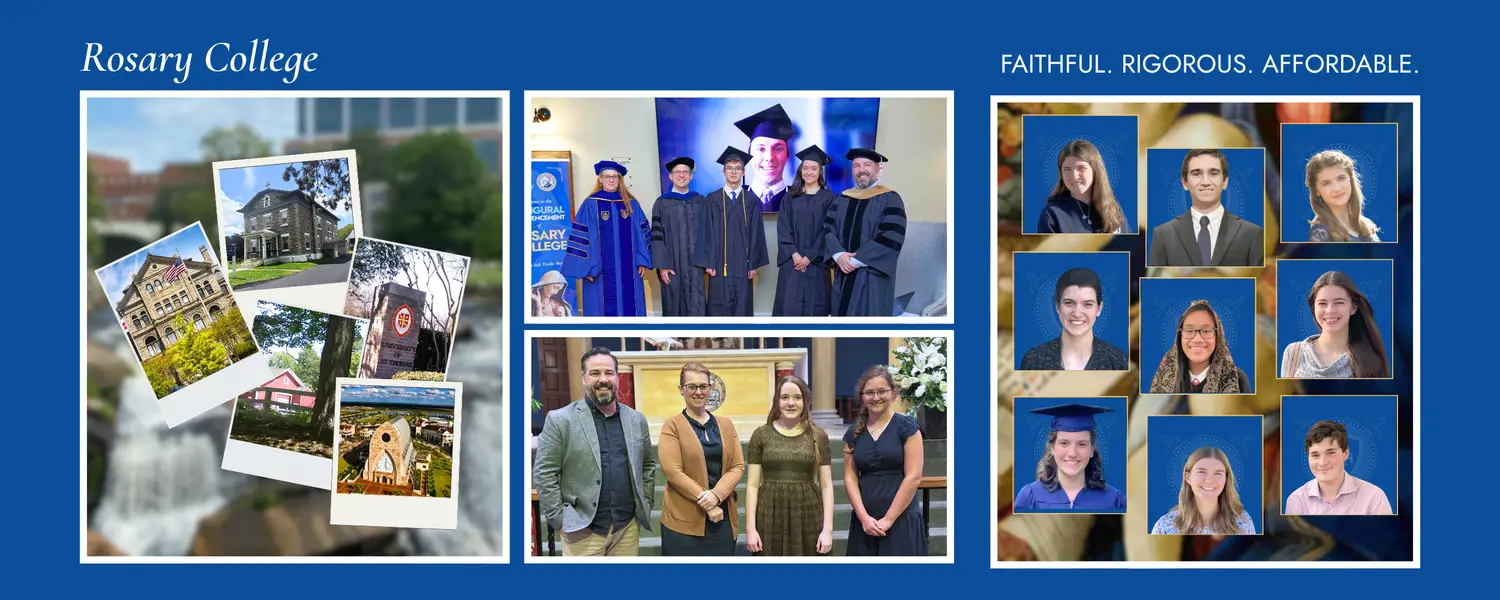
If you are searching for an authentically Catholic liberal arts education online — one rooted in the Catholic intellectual tradition, taught by distinguished Catholic scholars, and affordable enough to make serious education genuinely possible — we built Rosary College for you.
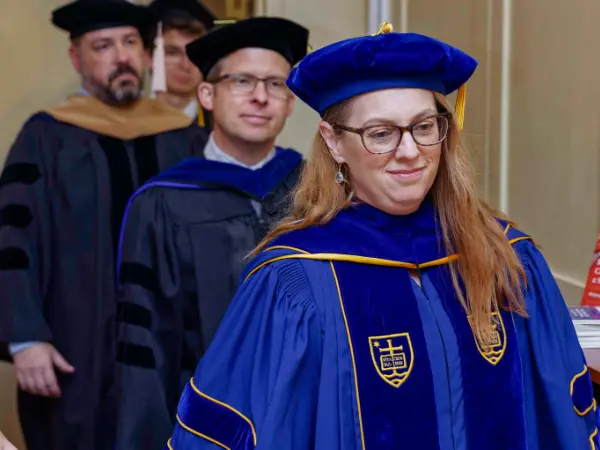
“The mission of this college is not simply to provide knowledge, but to form students to recognize what is true, to love what is good and what is beautiful, and to live in freedom — freedom ordered to reality and to God.”
— Dr. Elizabeth L’Arrivée, charge to the inaugural graduates
We offer the Associate of Catholic Studies (ACS) in Integrated Humanities entirely online through live, synchronous seminars rooted in the Catholic intellectual tradition. Rosary College is South Carolina’s first Catholic college and has received Gold provisional recognition from the Cardinal Newman Society’s Newman Guide. Our curriculum combines rigorous Great Books education with personal instruction, small classes, and a fully integrated Catholic vision of the liberal arts. Credits transfer to Ave Maria University, Thomas More College of Liberal Arts, the Catholic University of America, Walsh University, the University of Houston, Our Lady Seat of Wisdom, and additional partner institutions. Tuition remains intentionally affordable at $196 per credit hour. Enrollment for Fall 2026 is now open.
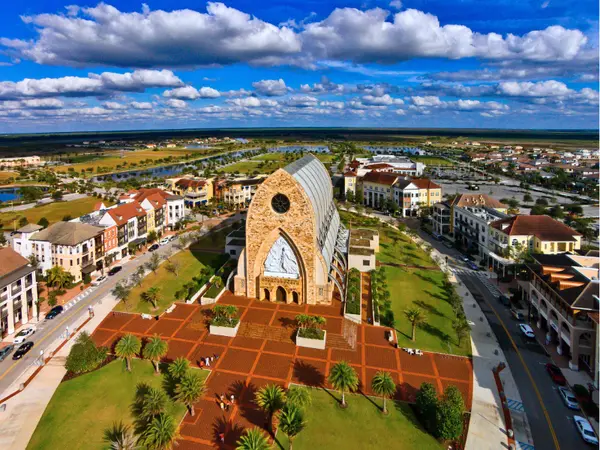
Ave Maria, FL

Washington D.C.
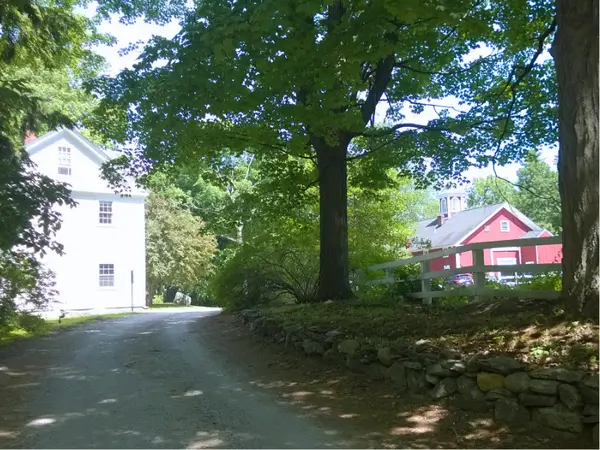
Merrimack, NH
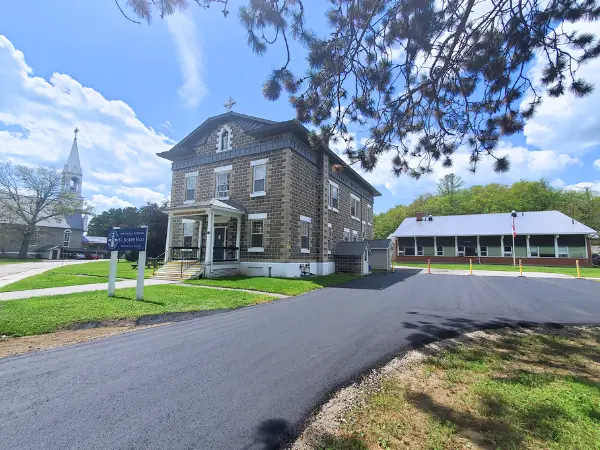
Barry’s Bay, Ontario
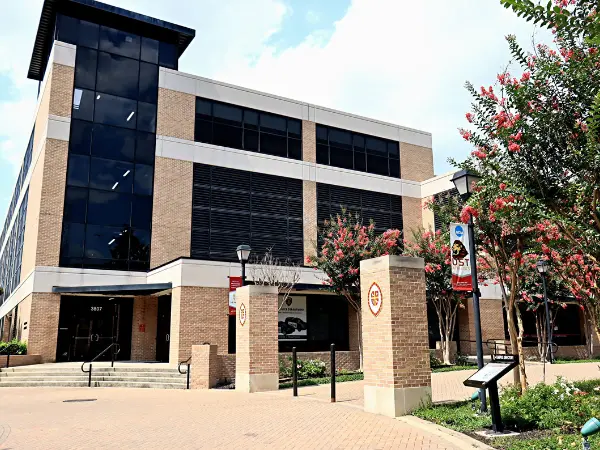
Houston, TX
North Canton, OH
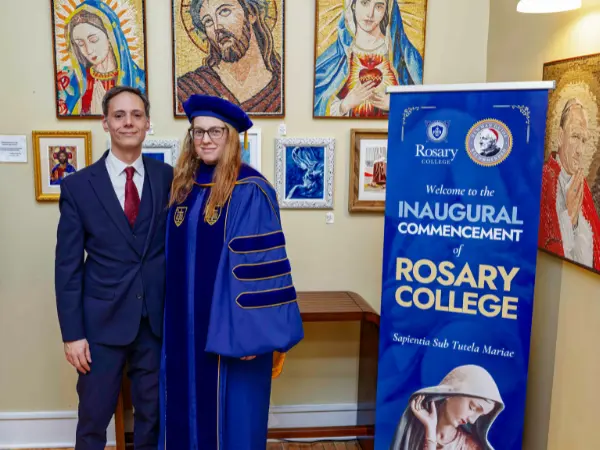
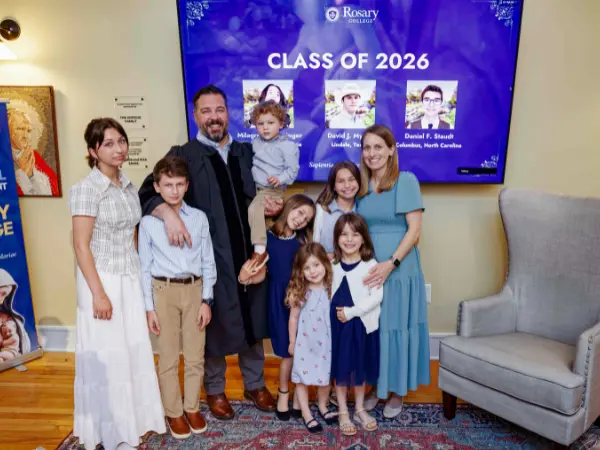
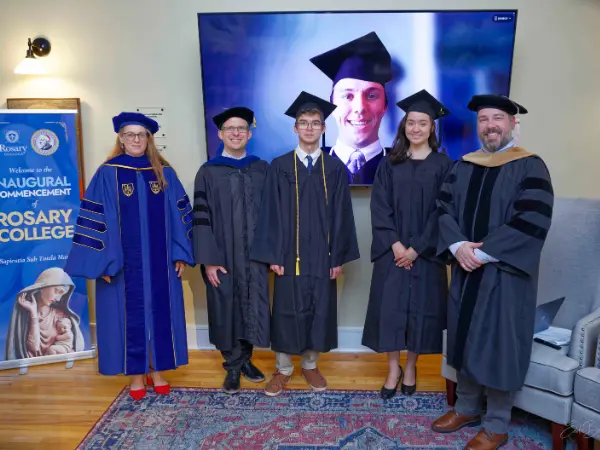
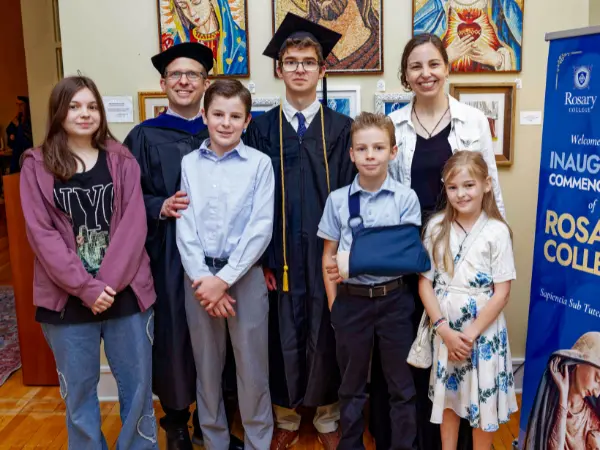
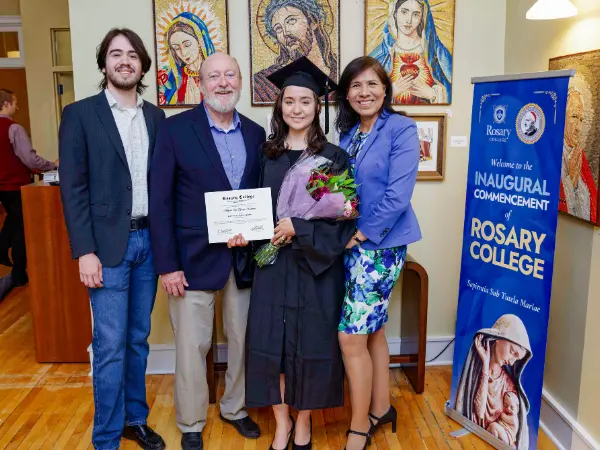
In May 2026, we held our inaugural commencement ceremony, conferring degrees on the first students to complete the program. For prospective students and parents considering an online Catholic liberal arts college, the ceremony offered more than a graduation celebration. It revealed, in concrete form, the kind of education we are attempting to provide and the kind of graduates we hope to form. At a time when many colleges speak in broad and interchangeable language about “leadership,” “innovation,” or “career readiness,” our first commencement reflected something more specific: a faithful Catholic college centered on intellectual seriousness, personal formation, live engagement with faculty, and the conviction that education ultimately concerns truth, freedom, beauty, and holiness.
Many Catholic colleges offer humanities courses. Far fewer attempt to recover the Catholic liberal arts tradition as an integrated form of education — one in which literature, philosophy, theology, sacred music, rhetoric, mathematics, Scripture, and the arts are studied together as parts of a coherent vision of reality. That is the tradition we are trying to serve at Rosary College.
Our curriculum is organized around direct engagement with primary works rather than summaries or textbooks. Students encounter Homer, Augustine, Boethius, Dante, Shakespeare, the Gospels, Botticelli, Gregorian chant, sacred polyphony, and the philosophical and theological tradition of the Church in live seminars led by faculty deeply formed within those traditions themselves. The goal is not merely the acquisition of information, but the cultivation of judgment, contemplation, and intellectual friendship.
“The goal is not merely the acquisition of information, but the cultivation of judgment, contemplation, and intellectual friendship.”
Our founding faculty reflects that ambition. Professor Joseph Pearce — internationally recognized biographer of Tolkien, Chesterton, Belloc, and Shakespeare — teaches in the Humanities sequence after decades spent teaching Catholic literature and culture. Dr. R. Jared Staudt, former Academic Dean of the Augustine Institute and former Director of Catholic Studies at the University of Mary, brings extensive experience in Catholic formation and theological education. Dr. Elizabeth L’Arrivée, who teaches philosophy, rhetoric, and writing, holds a doctorate from the University of Notre Dame and has taught in Great Books programs at Clemson University and Colgate University. Our broader faculty includes scholars in mathematics, philosophy, literature, theology, rhetoric, science, and law, all teaching within the Catholic intellectual tradition. Every member of our faculty is Catholic and faithful to the Magisterium, a commitment reflected in Rosary College’s Gold recognition from the Cardinal Newman Society’s Newman Guide.
Equally important is the form the education takes. Average class size during the Fall 2025 semester was nine students, with a student-to-professor ratio of approximately 9:1. These are not asynchronous survey courses or prerecorded lecture modules. Courses meet live, in real time, as Socratic seminars in which faculty and students are genuinely present to one another and to the text under discussion. Our scale allows students to become known personally by their professors — not as numbers moving through a system, but as individual minds and souls undergoing formation.
Rosary College does not yet possess a traditional residential campus. We are still a young institution, and our long-term vision includes the development of a brick-and-mortar campus as enrollment grows. Yet the absence of a conventional campus has not meant the absence of community, shared intellectual life, or meaningful academic culture.
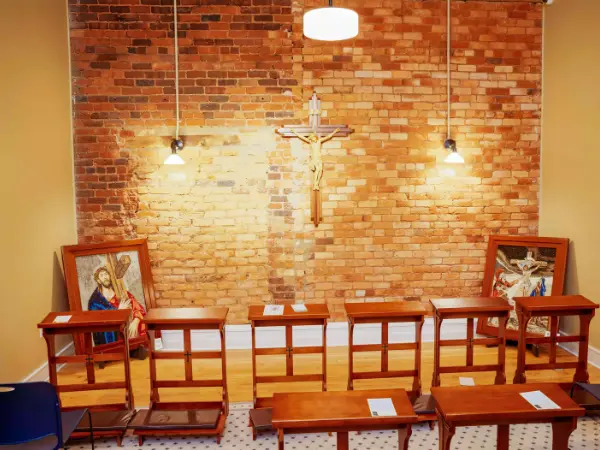
Our inaugural commencement ceremony was held in association with Christ on Main in downtown Greenville, South Carolina, a Catholic center dedicated to prayer, study, community life, and the renewal of Catholic culture in the heart of the city. Situated within one of the fastest-growing cities in the South and within a flourishing Catholic community, Christ on Main reflects much of what we hope to cultivate intellectually and spiritually at Rosary College: beauty, contemplation, hospitality, and serious conversation rooted in the Catholic tradition.
Greenville has increasingly become a center of Catholic renewal in the region, with parishes including Our Lady of the Rosary, Prince of Peace, St. Mary Magdalene, and St. Mary’s serving a growing population of Catholic families, educators, and professionals. The Blue Ridge foothills remain visible at the edge of the city, and the combination of natural beauty, civic vitality, and religious life has made Greenville an increasingly attractive destination for Catholic families seeking serious educational alternatives. Our partnership with Christ on Main situates the college within that wider cultural and spiritual landscape even before a permanent campus is established.
In some respects, the college’s current form has reinforced rather than diminished its educational character. We remain small enough that faculty know their students personally, students regularly interact across courses and events, and the intellectual life of the college remains visibly tied to actual human relationships rather than administrative scale. The annual Benedictine Colloquium, the St. Thomas Aquinas Lecture, student writing through the Totus Tuus blog, and in-person gatherings associated with the college all contribute to a growing academic and spiritual community that already possesses a distinctive institutional identity.
For prospective students and parents searching for an online Catholic liberal arts college, our inaugural commencement ceremony offered more than a graduation celebration. It provided a concrete picture of the kind of Catholic education we are attempting to offer and the kind of graduates we hope to form. At a time when many colleges rely on broad language about “leadership,” “innovation,” or “career preparation,” our first commencement revealed something more distinctive: a faithful Catholic college rooted in the Great Books tradition, live seminar-based learning, personal mentorship, and the conviction that education concerns truth, freedom, beauty, and holiness.
The commencement ceremony reflected the character of the institution itself. Every graduate belonged to the founding cohort of our Associate of Catholic Studies program. Every student enrolled before the college possessed a traditional brick-and-mortar campus or an established public reputation. These students completed a rigorous Catholic liberal arts curriculum while we were simultaneously developing faculty, transfer partnerships, academic programming, and the institutional foundations for future growth.
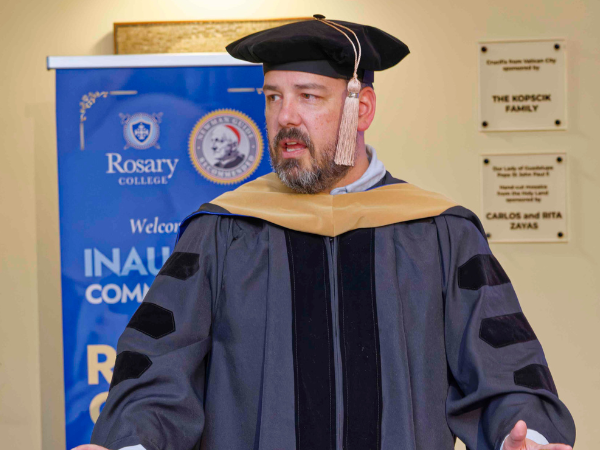
“We’ve been building the airplane while flying it.”
— Dr. Michael Shick
What emerged from that process became visible throughout the ceremony. The speeches were intellectually serious and unmistakably Catholic in character. Faculty spoke about students they genuinely knew personally through small, live online seminars and sustained academic formation. The graduates themselves demonstrated fluency with Plato, Boethius, Augustine, Scripture, sacred music, geometry, Latin, and the broader Catholic intellectual tradition — not as disconnected academic subjects, but as parts of an integrated liberal arts education ordered toward wisdom.
For families considering an affordable online Catholic college for Fall 2026, the inaugural commencement functioned, in many respects, as a public demonstration of our educational vision. It showed not only what we teach, but what kind of intellectual, moral, and spiritual culture we seek to cultivate through our online Catholic liberal arts degree program.
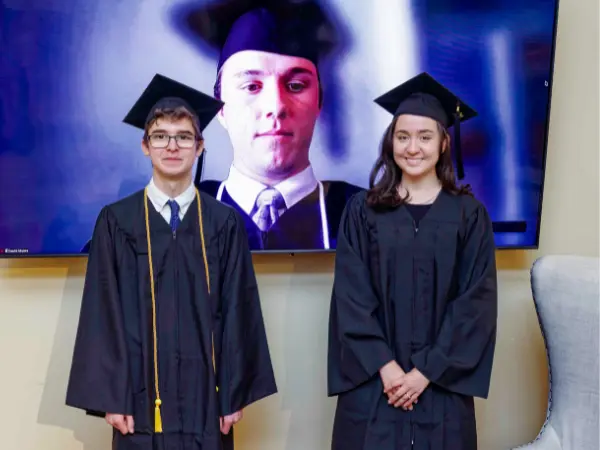
The inaugural graduates were Milagros C. Eppinger of Flowery Branch, Georgia; David J. Myers, cum laude, of Lindale, Texas; and Daniel F. Staudt, summa cum laude and valedictorian, of Columbus, North Carolina. Each completed the sixty-credit-hour Associate of Catholic Studies degree in Integrated Humanities.
The ceremony itself reflected the intellectual and spiritual seriousness of the institution. Professor Joseph Pearce, unable to attend in person, addressed the graduates in a letter centered on the Catholic image of Homo Viator — man as pilgrim and wayfarer.
Valedictorian Daniel Staudt delivered a philosophically rich meditation on liberal education, drawing on Boethius, Plato, Botticelli, Palestrina, geometry, Latin, and the Gospel of Mark to argue that true education restores the human person’s capacity to perceive reality truthfully.
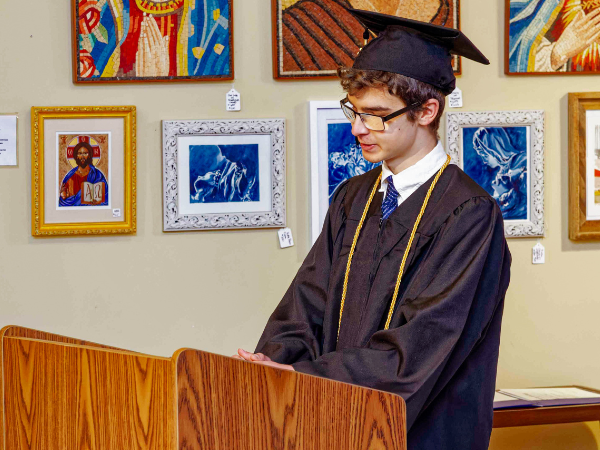
“True education is sanctifying. What, finally, has our liberal education done for us? We have seen God.”
— Daniel F. Staudt, valedictorian, Class of 2026
The formal commencement address was delivered by Dr. R. Jared Staudt, former Academic Dean of the Augustine Institute and current Vice Chairman of Rosary College’s Board of Trustees. His address reflected on the Rosary, Benedictine spirituality, sacrifice, and sainthood as the proper culmination of Catholic education. The purpose of education, he argued, is not merely professional success or self-development, but holiness itself.
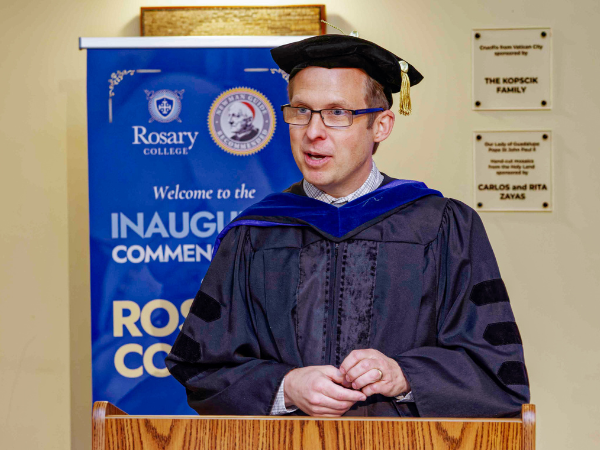
“The only real sadness, the only real failure, the only great tragedy in life, is not to become a saint.”
— Léon Bloy, cited by Dr. R. Jared Staudt
The charge to the graduates, delivered by Dr. Elizabeth L’Arrivée, brought the ceremony to its philosophical center. Drawing on Socrates, Montesquieu, Tocqueville, Augustine, and Scripture, she reflected on fear, freedom, conscience, and the moral costs attached to fidelity to truth. The address carried the unmistakable mark of a college small enough that its professors genuinely know their students. Speaking directly to graduates she had personally taught over the course of two years, she reflected not only on what they had learned, but on the people they had become.
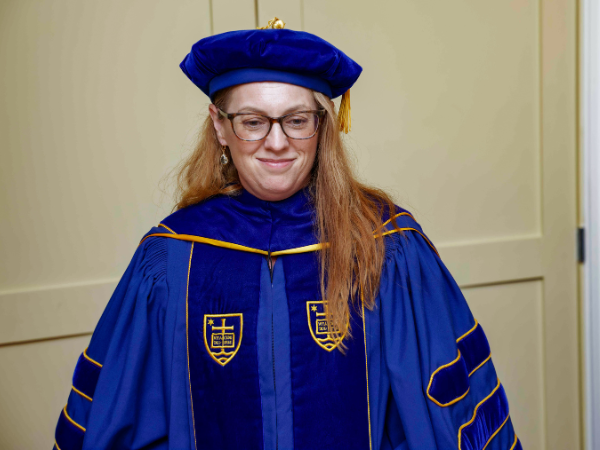
“Today, we celebrate not only what you have learned, but who you have become.”
— Dr. Elizabeth L’Arrivée
Rosary College’s curriculum unfolds as a four-semester journey through the Western Catholic tradition. The Humanities sequence begins with HUM 101: Classical Epic and Tragedy, proceeds to HUM 201: Medieval Literature and Culture, continues with HUM 301: Early Modern Literature and Culture, and culminates in HUM 401: Modern Literature and Culture. Across those semesters, students study literature, philosophy, theology, art, music, and history within their historical and intellectual contexts.
The broader curriculum integrates Sacred Scripture and Catholic Doctrine, Sacred Art, Sacred Music, rhetoric and speech, Elements of Writing, Euclidean geometry and mathematics, natural science, Latin, ethics, philosophy, servant leadership, and business. Writing and oral communication are emphasized throughout the program, and the course of study culminates in a capstone thesis project.
Rather than relying primarily on secondary commentary, students spend sustained time with the works themselves: Homer, Augustine, Dante, Boethius, Shakespeare, the Gospels, Renaissance sacred art, classical geometry, Gregorian chant, sacred polyphony, and the major literary and philosophical works of the modern world. The curriculum aims not merely at cultural literacy, but at formation in intellectual attention, judgment, and contemplation.
Students and families searching for faithful Catholic higher education increasingly face a difficult combination of problems: rising tuition costs, declining confidence in institutional mission, depersonalized online education, and curricula detached from the Catholic intellectual tradition itself. Rosary College has emerged, in part, as a response to those concerns.
The Associate of Catholic Studies degree offers a serious liberal arts formation at a cost dramatically lower than most comparable institutions. Full-time tuition remains $2,940 per semester before fees, while dual-enrollment students pay a reduced rate of $155 per credit hour. Courses remain live and discussion-based rather than self-paced. Faculty remain accessible. The curriculum remains explicitly Catholic in structure and purpose.
For homeschool families, dual-enrollment students, adult learners, and students seeking a transfer pathway into faithful Catholic higher education, the model has proven particularly attractive. Credits transfer to institutions including Ave Maria University, Thomas More College of Liberal Arts, the Catholic University of America, Walsh University, the University of Houston, and Our Lady Seat of Wisdom. Additional partnerships continue to develop as the college grows.
Rosary College’s inaugural class demonstrated something important: a small Catholic institution without a traditional campus, built deliberately around intellectual seriousness, faithful Catholic formation, personal instruction, and affordability, can succeed. Our commencement addresses reflected not institutional branding language, but genuine intellectual and spiritual formation. That may ultimately be the clearest indication of what we are attempting to build — and why students and families are beginning to seek it out.
“Do not surrender your judgment for the sake of ease or approval.”
— Dr. Elizabeth L’Arrivée, charge to the graduates
We offer the Associate of Catholic Studies (ACS) in Integrated Humanities, a sixty-credit-hour liberal arts degree rooted in the Catholic intellectual tradition.
Courses are currently offered online through live, synchronous seminars. Classes are discussion-based and meet in real time with faculty and students present together.
Yes. Every member of our faculty is Catholic and faithful to the Magisterium of the Catholic Church. Rosary College has also received Gold provisional recognition from the Cardinal Newman Society’s Newman Guide.
Yes. We actively welcome homeschool students, dual-enrollment students, adult learners, and transfer students.
Tuition is $196 per credit hour. Dual-enrollment students and senior citizens receive a reduced tuition rate of $155 per credit hour.
Yes. Rosary College has transfer partnerships with Ave Maria University, Thomas More College of Liberal Arts, the Catholic University of America, Walsh University, the University of Houston, Our Lady Seat of Wisdom, and additional institutions.
Faculty include Professor Joseph Pearce, Dr. R. Jared Staudt, Dr. Elizabeth L’Arrivée, Dr. Alex Lessard, Dr. Martino Rabaioli, Dr. Joseph Esparza, Dr. Amie Bray, Dr. Daniel Brennett, Dr. Tyler Graham, Dr. Michael Shick, Thomas Curtin, Esq., and Dr. Anthony Antunes.
We combine live seminar-based instruction, small class sizes, faithful Catholic formation, Great Books education, affordability, and direct engagement with the Catholic intellectual tradition.
If you’re ready to join a community committed to wisdom, truth, and the greater good, start your application today!
Do you want to learn more or have questions? Attend one of our weekly Wednesday information sessions.
Contact Us
Faithful. Rigorous. Affordable.
a lecture series by Rosary College